knowledge bank
Expert resources and insights on open optical networking.

WDM
What is DWDM and when should you use it?
The connected society now taking shape depends on robust and future-proof networking solutions for a range of fiber optic network applications – from corporate and governmental data centers to service provider networks. DWDM is increasingly a key ingred...

WDM
What 400ZR means for todays DCI and metro networks
Both enterprise data centers and metro networks face increasing data traffic as the connected society takes hold, which puts pressure on network performance. This has driven the development of 400ZR for enabling 400G speeds with flexible hardware config...

WDM
Four ways of transporting data optical network
The most common approaches for transporting data over a fiber network is by using single channel connectivity, embedded XWDM solutions or active, transponder-based WDM platforms. Each alternative is based on an organization’s access to dark fiber, eithe...

WDM
The role of transponders and muxponders in fiber networks
Enterprise data centers and service providers face increasing demands for data security, low latencies, higher speeds and longer distances in their networks. Transponders and muxponders are both key components for upgrading and enhancing their network i...

WDM
Software-Defined Networking (SDN) explained
As enterprise and service provider networks have grown in size and scale, they have also become more complex and challenging to manage. One of the main drivers of this complexity has been the rise of disaggregated networks comprising components from dif...

WDM
The role of fiber optics technology
As the world has grown more connected and data consumption has increased exponentially, methods of transmitting data have become all the more important. From a technological standpoint, fiber optics has served as a key enabler of these trends, setting a...
WDM
What is WDM? – How wavelength division multiplexing works and when to use it
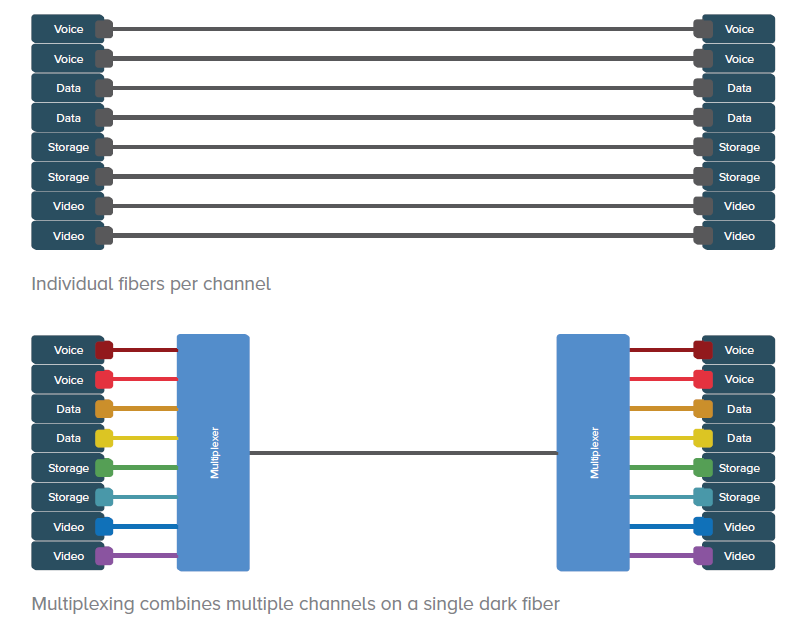
Wavelength division multiplexing, WDM, has long been the technology of choice for transporting large amounts of data between sites. It increases bandwidth by allowing different data streams to be sent simultaneously over a single optical fiber network....

WDM
How ROADMS pave the way for tomorrow’s fiber optic networks
We live in a world that is changing faster than ever, and that includes fiber optic network requirements. This means you will probably need to assign bandwidth and multiplex channels differently sooner or later. As a result, ROADM technologies have beco...

WDM
How metro networks emerged and what the future has in store
Driven by a general increase in data consumption in society and industry, higher bandwidth requirements have network operators looking to upgrade their metro networks. With new speeds and standards on the horizon, service providers and operators are cha...

WDM
The evolution of data center interconnect (DCI) solutions
Data center networking was initially focused on traffic within a single data center. However, over time connections between two or more data centers have become increasingly important. This is where data center interconnect (DCI) solutions come into pla...

WDM
CWDM vs DWDM explained: key differences and when to use each
The two key WDM technologies are Coarse Wavelength Division Multiplexing, CWDM and Dense Wavelength Division Multiplexing, DWDM. Which solution is best suited to a given environment depends on the network and user requirements.
Article
Verizon validates Smartoptics open line system with PAM4 for 400G connectivity
Inphi Corporation and Verizon Media have successfully validated an upgrade from 100G PAM4 optics to 400G QSFP-DD over the same open line system from Smartoptics. By demonstrating how 100G investments can be made future-proof with easy 400G support, this...